resources
Visualizations and course materials, by subject, in the units where an English version exists. The full catalog is in Spanish.
Network Architecture I
unit 1
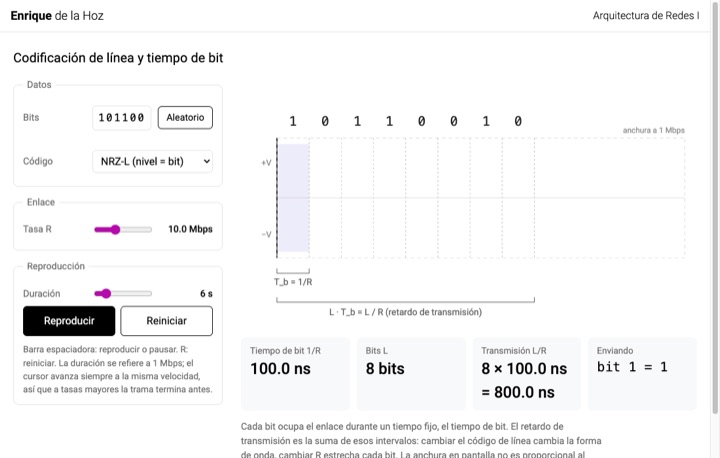
Line coding and bit time
Encode a frame in NRZ-L, NRZ-I or Manchester and see that every bit occupies the link for a fixed time, 1/R. That is where the transmission delay, L/R, comes from.
Session 1.1Versión en español
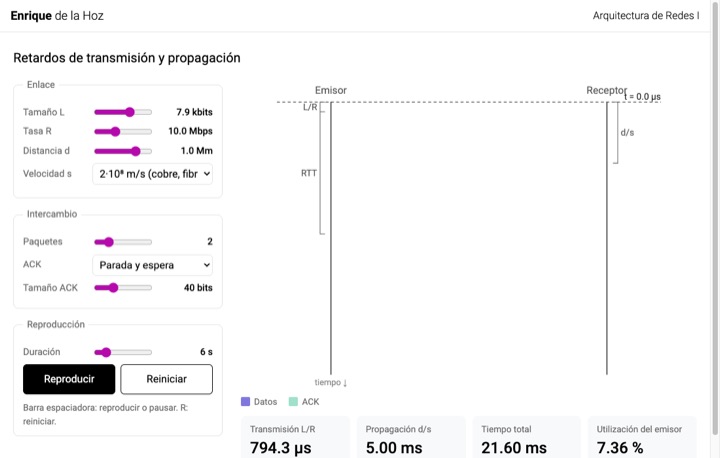
Transmission and propagation delay: space-time diagram
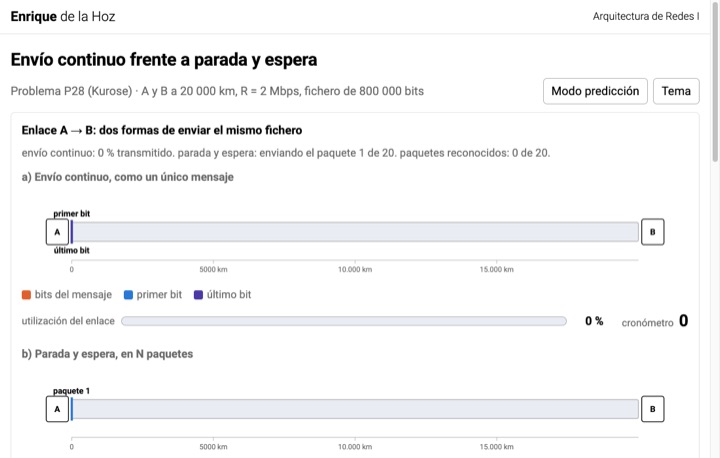
Adjust size, rate, distance and propagation speed and follow the packets between sender and receiver. Compare stop-and-wait with pipelining and the sender's utilization.
Session 1.1Versión en español
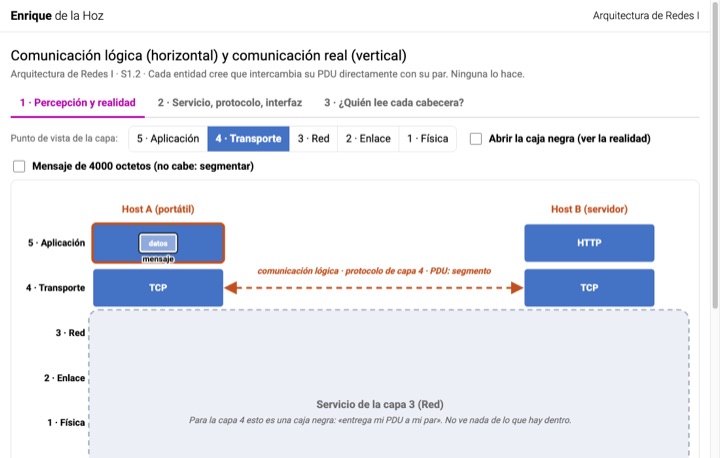
Logical vs real communication
Every layer believes it talks directly to its peer, but everything actually goes up and down the stack. Walk through service, protocol and interface and find out who reads each header in the frame.
Session 1.2Versión en español
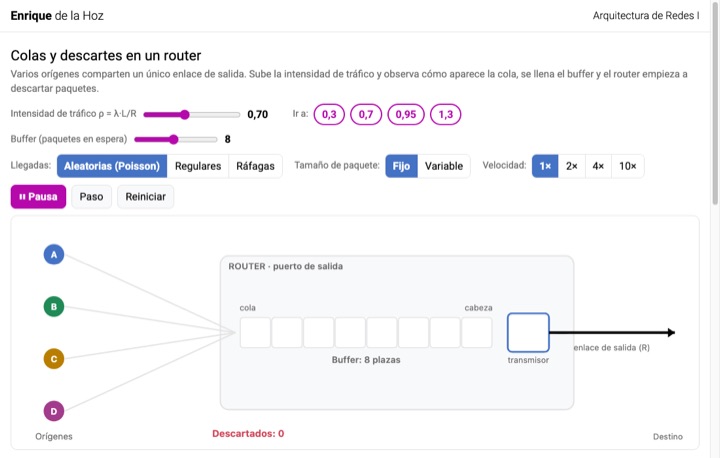
Queueing and packet drops in a router
Several sources share one outgoing link. Raise the traffic intensity ρ = λ·L/R and watch the queue grow, the buffer fill up, and the router start dropping packets.
Session 1.3Versión en español
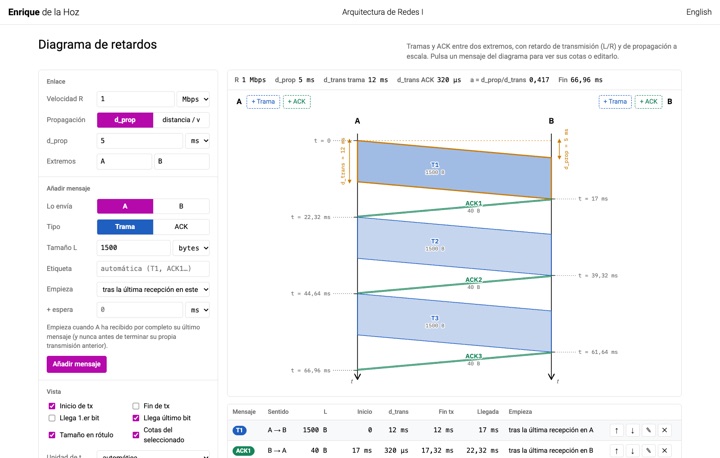

unit 1: delay lab
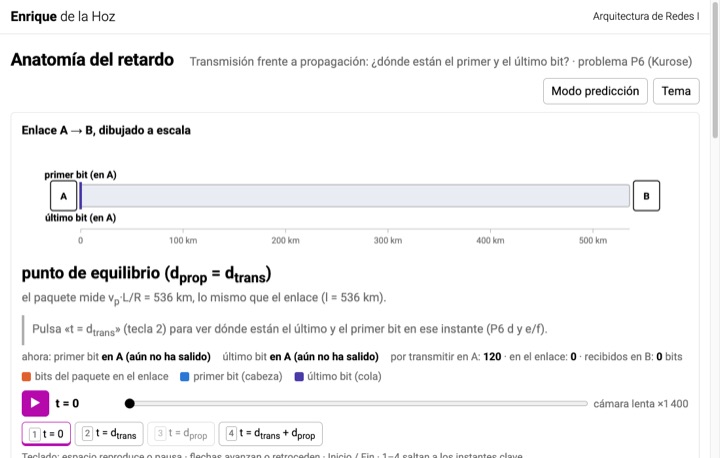
Anatomy of delay
Transmission versus propagation, where the first and last bit are, the equilibrium point, and a calculator for any problem statement.
Lab 1.2, problem P6Versión en español
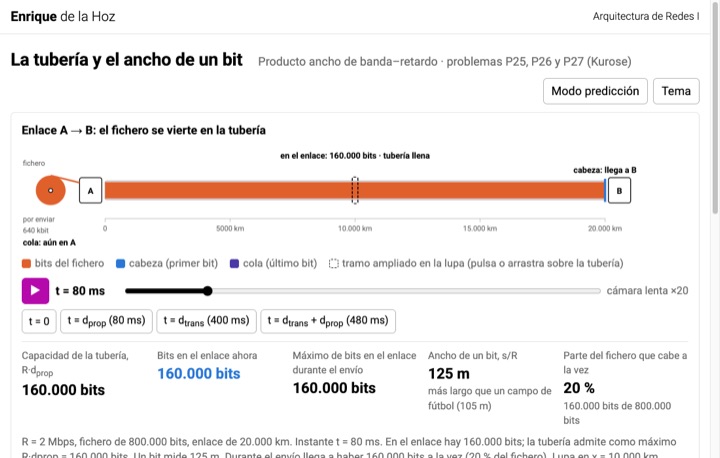
unit 2: DNS
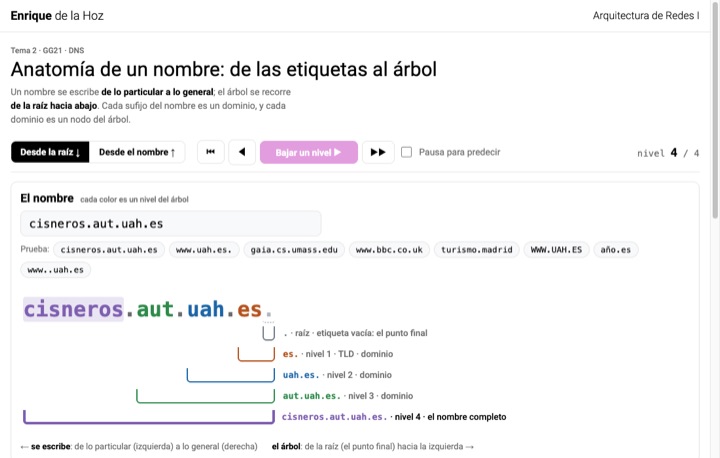
Anatomy of a name: from labels to the tree
Break any name into labels and domains and see it in the tree, from the root or from the name. Check the rules, 63 characters, trailing dot, case and punycode.
Session 2.1Versión en español
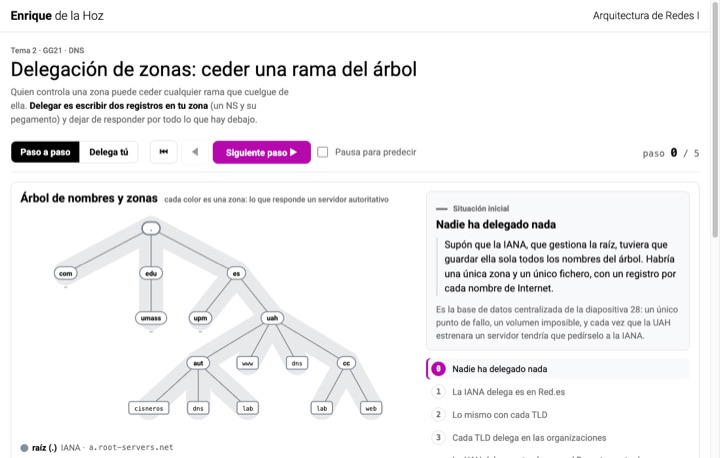
DNS zone delegation
Step by step through the IANA → Red.es → UAH → Department chain, with zone files. In "Delegate it yourself" you create domains and hosts and delegate them yourself, with NS records, glue and referrals.
Session 2.1Versión en español
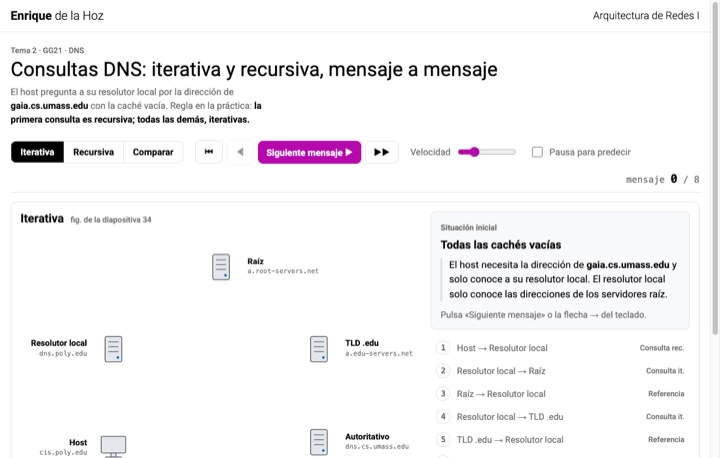
DNS queries: iterative and recursive
Message by message, resolving gaia.cs.umass.edu with an empty cache. Compare the two modes and notice who has to remember other people's queries.
Session 2.1Versión en español
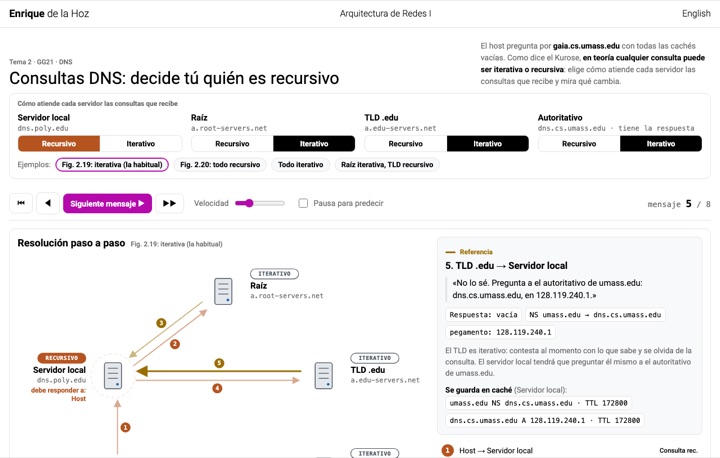
DNS queries: you decide who is recursive
The same resolution, but you choose whether the local server, the root, the TLD and the authoritative server work recursively or iteratively. Compare who sends the queries, who has to wait and where the answer ends up cached.
Session 2.1Versión en español
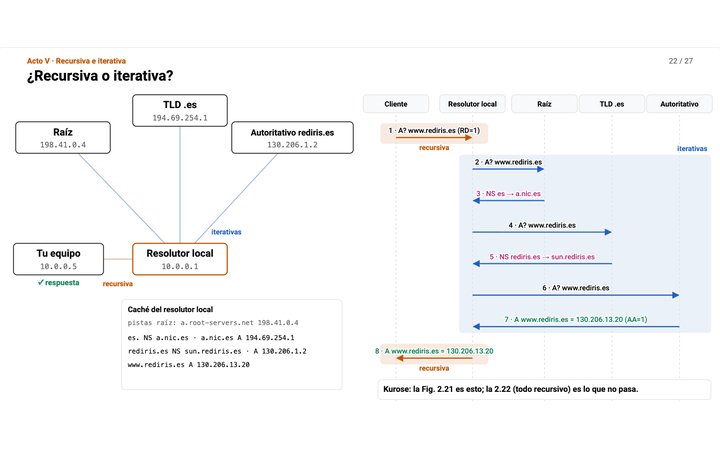
DNS step by step
The DNS told from the why in 27 steps, from why an IP address is not enough to a query followed message by message. Why we need names, how the tree is split up, what your computer sees and what happens behind it, and where each query is recursive or iterative.
Session 2.2Versión en español
unit 2: HTTP
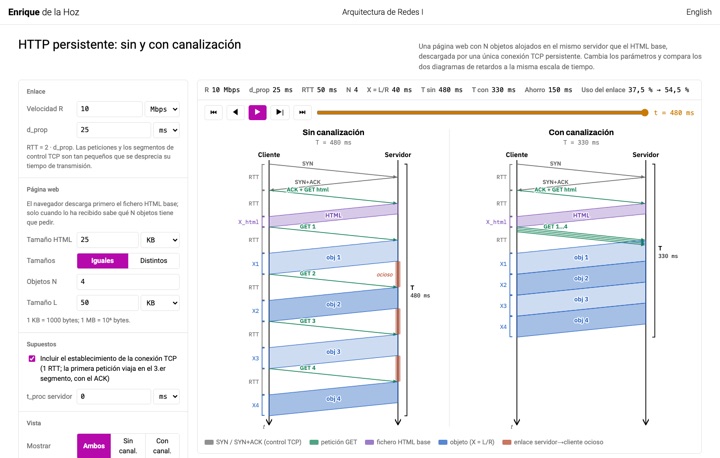
Persistent HTTP: without and with pipelining
A page with N objects downloaded over a single persistent TCP connection. Compare the delay diagrams without and with pipelining on the same time scale, see when the link sits idle and practise with random exercises.
Session 2.2Versión en español
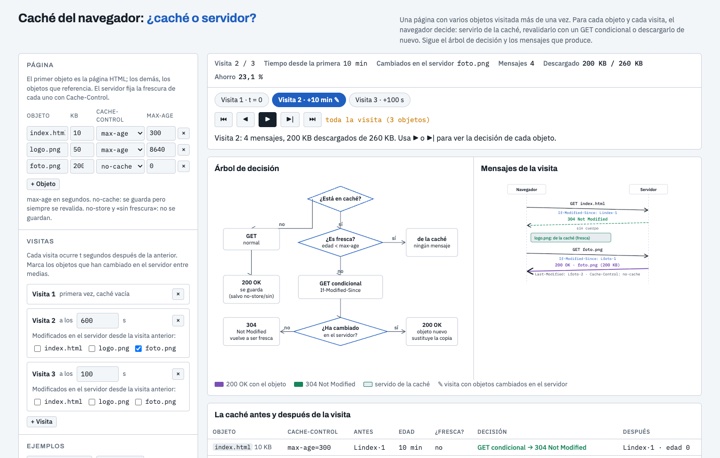
Browser cache: cache or server?
A page with several objects visited several times. For each object, the browser follows the decision tree: serve it from the cache, revalidate it with a conditional GET (304 or 200) or download it again. Follow the path in the tree, the messages and the cache state, and practise with exercises.
Session 2.3Versión en español
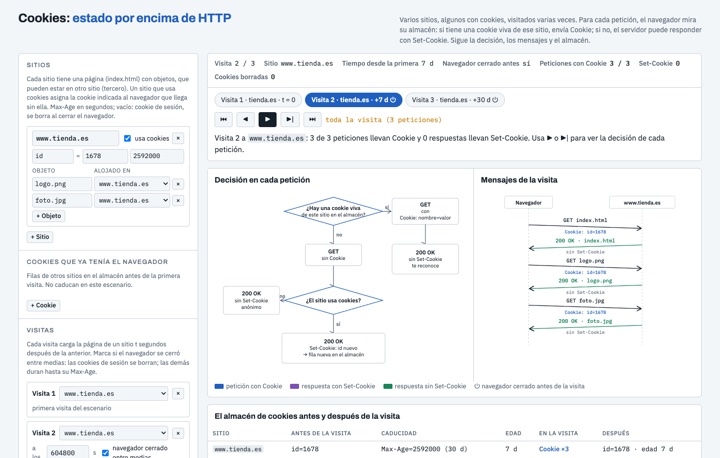
Cookies: state on top of HTTP
Several sites, some of which use cookies, visited several times. For each request the browser looks in its cookie store: if it has a live cookie for that site it sends Cookie; if not, the server may answer with Set-Cookie. Follow the decision, the messages, the store and what each server knows; practise with exercises.
Session 2.3Versión en español
unit 3: the transport layer
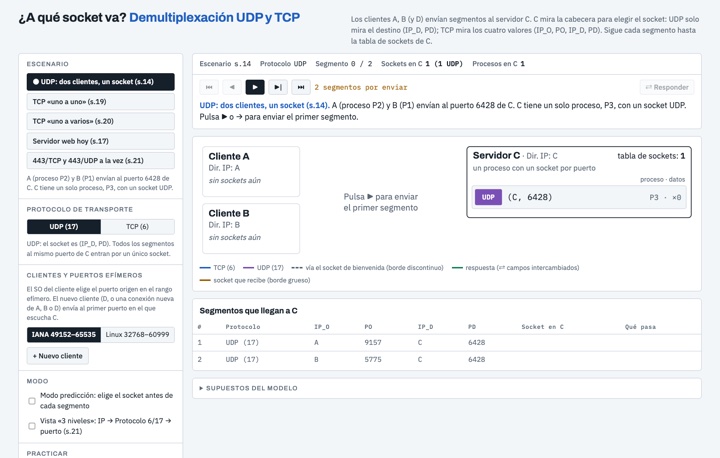
Which socket? UDP and TCP demultiplexing
Clients A, B and D send segments to server C, which chooses the socket from the header: UDP only looks at the destination (IP_D, PD); TCP at the four values. Welcome and connection sockets, the reply with swapped ports, ephemeral ports, prediction mode and exercises.
Session 3.1Versión en español
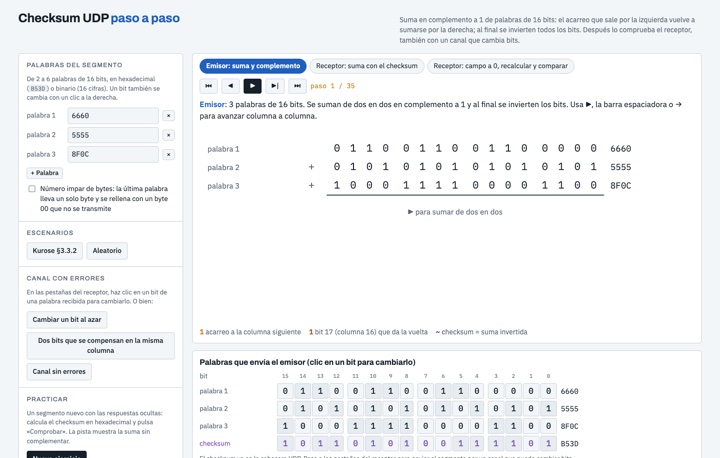
UDP checksum step by step
One's complement sum of 16-bit words, column by column: the carry that leaves on the left wraps around and is added on the right, and at the end the bits are inverted. Check the checksum as the receiver in both ways and flip bits in the channel to see which errors are detected.
Session 3.1Versión en español
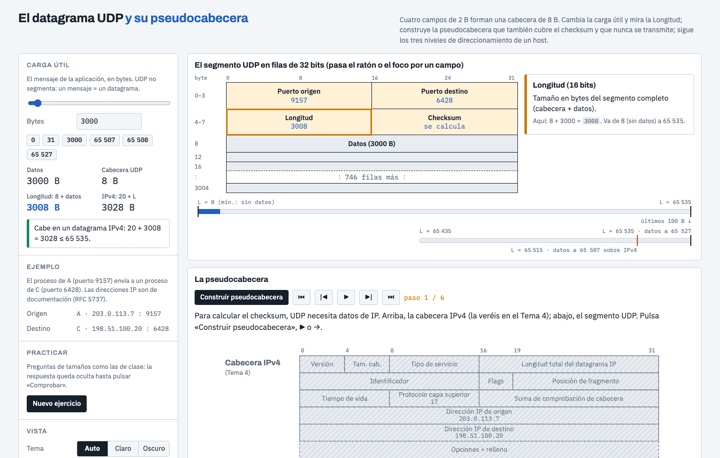
The UDP datagram and its pseudo-header
The UDP header in 32-bit rows, with an explanation of each field. Change the payload and watch the Length update and where the limits are; build the pseudo-header from the IPv4 header and follow the three levels of addressing: IP, protocol 6/17 and port.
Session 3.1Versión en español
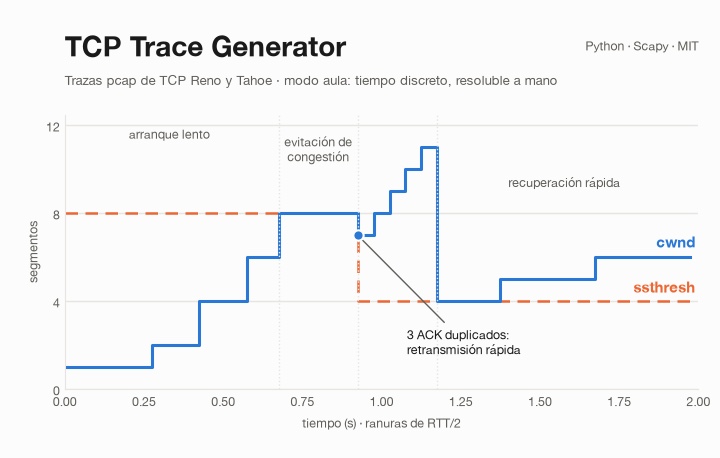
TCP trace generator
Python and Scapy script that simulates a TCP connection (Reno or Tahoe) and produces the pcap capture and a log of the internal state (cwnd, ssthresh, RTO). Classroom mode uses discrete time slots and predictable behaviour for congestion control exercises.
Code on GitHub · session 3.4DOI 10.5281/zenodo.23293176Versión en español